I talk a lot on this channel about the practical side of making money with 3D printing what to sell, which printer to use, how to price. But sometimes the most useful thing isn't a tutorial. It's seeing someone else's path and recognizing something in it.
Hector's story resonates with me because it started the same way mine did: with genuine curiosity about what this technology could do, before there was any business attached to it. The business came later, because the curiosity kept pushing forward.
HOW 3DREAM STUDIO STARTED
3Dream Studio was founded in 2021 in Ciudad Obregón a mid-sized city in the Sonora region of Mexico that Hector himself describes as a place where 3D printing is still relatively new and many people aren't yet aware of its possibilities. That context matters, because it shaped how the studio positioned itself from day one.
In a market where the technology is unfamiliar, you can't just open a print shop and expect customers to show up with files ready to go. Most people don't have files. Most people have problems a spare part that's no longer available, an idea for a custom product, a prototype they want to test. The studio built itself around those conversations, not around production volume.
"Customers come to us with an idea, a problem or simply with curiosity, and together we explore what is possible."
Hector Ureña, founder of 3Dream StudioThat collaborative approach working from the customer's problem rather than from a catalog is what distinguishes a small manufacturing studio from a commodity print service. It's also what makes it defensible. You can't easily replicate a relationship.
THE SETUP: BAMBU LAB FDM AND HIGH-RES RESIN
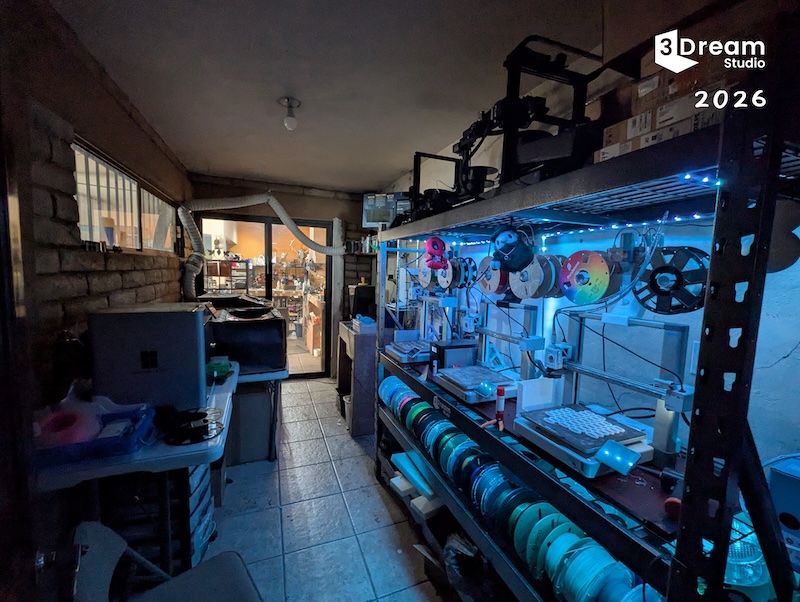
3Dream Studio runs a hybrid setup: FDM systems with multi-color capability based on Bambu Lab printers for larger or functional prints, paired with high-resolution resin printing on 12K devices from Elegoo for detail-heavy work. The workflow is rounded out with laser engraving, laser cutting, vinyl cutting, and sublimation.
This is worth paying attention to. Hector didn't plant a flag on one technology and call it done. He built out a toolkit that lets the studio match the right process to the right job. A Bambu Lab FDM machine is excellent for functional parts, custom goods, and multi-color production runs. A 12K resin printer is excellent for miniatures, jewelry, dental models, and anything where surface detail matters more than material strength.
The Bambu Lab angle is relevant: Running multicolor FDM on Bambu machines is what I do too. The speed and reliability at that price point genuinely changes what's possible for a small studio it's not a hobbyist tool anymore, it's production infrastructure.
The combination of digital fabrication tools print, engrave, cut also means the studio can handle more complex jobs end-to-end. A personalized gift that involves a 3D printed component, a laser-engraved element, and a vinyl transfer is something a single-technology shop can't do. 3Dream can.
WHAT THE WORK ACTUALLY LOOKS LIKE
The most interesting projects at 3Dream Studio come from people who arrive not with a design, but with a need. Hector describes a recurring pattern: someone has a problem a component that broke and is no longer manufactured, a custom part for a specific application, a prototype for a product idea and they come to the studio to figure out if 3D printing can solve it.
That problem-solving role is where the real value is. Anyone can run a print job. Fewer people can take a customer's vague description of what they need, adapt a geometry for printability, revise it through a few iterations, and deliver something that works. That's a skill, and it takes time to develop but it's also what commands real prices.
3Dream also makes personalized objects, promotional items, and small production batches for local businesses. Promotional items in particular are a strong market for small 3D printing studios: companies with small budgets who need branded physical objects in quantities too small to justify traditional manufacturing.
THE HUMAN SIDE OF A LOCAL STUDIO
Something Hector said in his interview stood out to me: he mentioned that he's always found it hard to actively sell products, because his instinct is to make things for people because he knows they'd enjoy them not primarily as a transaction.
That instinct is a double-edged thing in business. On one side, it leads to customer relationships that are genuinely different from what a bigger, more transactional operation provides. People who come to 3Dream Studio are working with someone who actually cares about the outcome of their project and that's rare, and valuable, and the kind of thing that generates word-of-mouth referrals in a local market.
On the other side, that same instinct can make it harder to price work appropriately and to think about growth in purely commercial terms. Most people who start with passion rather than a business plan have to learn the business part separately. Hector seems to be navigating that honestly, which is more than most people manage.
WHAT CHANGED BETWEEN 2021 AND NOW
Hector is direct about how fast the technology has moved since 3Dream launched. Modern printers are significantly more reliable, faster, and easier to use than what was available in 2021. Better design software has lowered the barrier to producing professional-quality work without industrial infrastructure.
That matters for anyone thinking about starting now versus waiting. The tool quality curve has been steep and consistent. What required a lot of technical knowledge and tolerance for failure five years ago is now genuinely accessible. A Bambu Lab A1 in 2025 ships calibrated, produces excellent results out of the box, and costs a fraction of what comparable quality required previously.
The implication: the barrier to entry has dropped, which means the competition has increased. But the demand has also grown, and the number of problems that 3D printing can now solve profitably has expanded significantly. In Hector's region, 3D printing is still early. In many markets, there's still a first-mover advantage to be had.
WHAT YOU CAN TAKE FROM THIS
Hector's path isn't a template it's specific to his market, his skills, and his approach. But a few things transfer cleanly:
Start with curiosity, not a business plan. The studios and businesses that work tend to come from people who were genuinely interested in the technology before they were interested in monetizing it. The quality shows. The adaptability shows.
Position around problems, not products. A shop that sells prints is competing on price. A studio that solves problems is competing on capability. Those are different businesses with different margins and different customer relationships.
Your local market is probably less saturated than you think. Ciudad Obregón isn't a tech hub. But there are businesses and individuals there with problems that 3D printing can solve, and not many people yet who can solve them. The same is probably true where you are.
The tools are good enough now. There's no meaningful advantage to waiting for better hardware. The Bambu Lab machines available today are production-grade for small-studio work. Start with what's available.
The pattern I keep seeing: The people making real money with 3D printing aren't the ones with the most expensive printers or the most followers. They're the ones who found a specific problem, built a specific solution, and showed up consistently. Hector's story is another data point in that direction.
What started in 2021 as a personal journey of discovery has become a studio that turns people's ideas into physical objects. That's not a small thing. Most people who get excited about a technology never build anything with it. Hector did and he keeps doing it.
That's the whole playbook, honestly.