I share a lot of content about making money with 3D printing Etsy shops, filament brands, print farm setups. But this story is different. Goodsmith isn't a hobby that turned into a side hustle. It's a company that looked at a centuries-old industry, identified something fundamentally broken about it, and realized that 3D printing specifically FDM with flexible materials was the only manufacturing method that could fix it.
THE PROBLEM WITH TRADITIONAL HORSESHOES
Horses have been wearing iron horseshoes for centuries. The basic concept hasn't changed much: a metal shoe nailed directly into the hoof wall, replaced every 6–8 weeks. It protects the hoof from wear but it comes with a serious list of trade-offs.
Nails driven into the hoof wall weaken the structure over time. Traditional metal shoes restrict the natural flex and movement of the hoof, which is actually a key part of how horses circulate blood and absorb impact. And because every hoof is shaped differently, getting a truly well-fitting shoe requires a skilled farrier working by hand which is expensive, time-consuming, and not always available.
The result: a lot of horses wearing shoes that are "close enough" rather than genuinely fitted. For performance horses or animals with hoof problems, that gap matters.
THE GOODSMITH SOLUTION
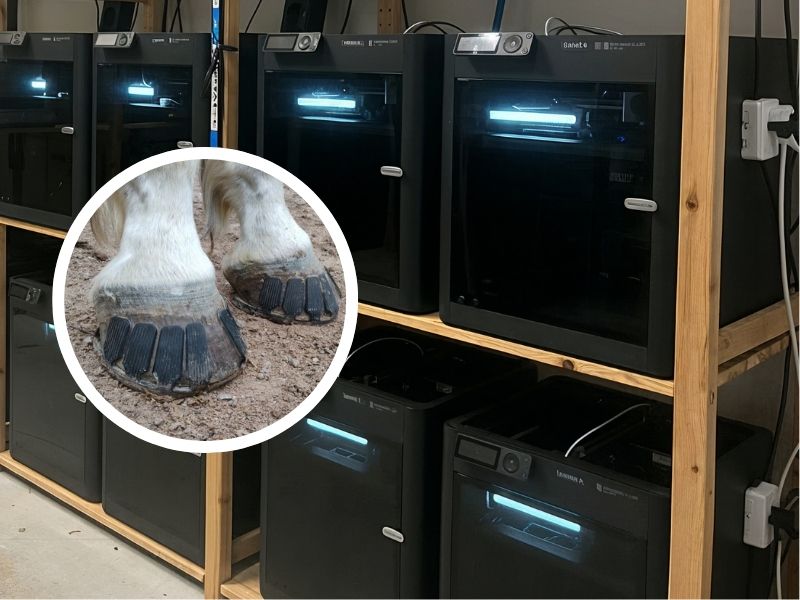
Goodsmith's approach throws out the nail and the metal entirely. Instead, they produce hoof protection components from thermoplastic polyurethane (TPU) a flexible, tough material that allows the hoof to move naturally while still providing protection. The products are attached with a single-component cyanoacrylate adhesive, making application simpler for farriers and horse owners.
The lineup includes adhesive fittings, modular hoof shoes, and accessories all designed around preserving the natural hoof mechanism rather than constraining it.
Why TPU specifically? Because the hoof is a dynamic structure that flexes under load. Rigid materials fight that movement. TPU moves with it which is why it protects tendons and joints rather than just the hoof surface. The material choice is the product.
WHY FDM AND NOT SLS OR MJF
This is the part of the story that's most relevant to anyone thinking about 3D printing as a manufacturing method for a real product. Before committing to FDM, Goodsmith founder Simon and his team tested three different 3D printing technologies under actual field conditions:
- Selective Laser Sintering (SLS) Failed under the abrasion and continuous load conditions that hoof protection products face
- Multi Jet Fusion (MJF) Also failed the wear and stress tests, and came in at higher cost
- FDM (Fused Deposition Modeling) The only technology that survived the real-world abuse a horse puts on its feet
FDM also won on cost. At the production volumes Goodsmith needs, it's significantly more economical than powder-bed technologies which matters a lot when you're building a physical product business with real margins to protect.
The conclusion they reached is one that's worth internalizing for anyone thinking about product development: don't pick your manufacturing method based on what sounds most advanced. Test under real conditions and let the results decide.
THE BUSINESS MODEL: MASS CUSTOMIZATION AT SCALE
Here's where it gets genuinely interesting from a business perspective. Goodsmith co-founder Bennet Klein has pointed to mass customization as a core long-term goal: custom-fitted solutions for each individual hoof, produced at the quality and consistency of serial manufacturing.
That's a fundamentally different value proposition than a standard product. You're not selling a size 7 horseshoe. You're selling a shoe that fits this specific horse's specific hoof, produced on demand, at a price point that works for the market.
This is exactly what 3D printing enables that injection molding or casting cannot: the ability to manufacture individually-customized parts without a cost penalty for variation. Each print job can be different. The tooling cost is zero.
At higher volumes, Goodsmith is exploring moving some components to injection molding which makes sense for standard parts where volume justifies the tooling investment. But products that need to stay flexible and customizable are planned to stay in 3D printing long-term.
The business insight here: Injection molding wins at high volume with fixed geometry. FDM wins when geometry varies and volumes are moderate. Goodsmith is building a hybrid that uses each technology for what it's actually good at.
WHAT MAKES THIS NICHE WORK
From a pure business model standpoint, the Goodsmith story has a lot going for it:
The market exists and has money. Horse owners spend significantly on animal care. A product that demonstrably improves hoof health and reduces farrier visits has a clear value proposition in a market that's used to paying for quality.
The problem is real and underserved. Traditional horseshoes haven't meaningfully changed in centuries. There's genuine room for a better approach not just a marginal improvement, but a fundamentally different philosophy about hoof care.
The product only works because of 3D printing. This is the key test for any product-based 3D printing business: is 3D printing genuinely the best manufacturing method, or are you just using it because you have a printer? For Goodsmith, the combination of custom geometry, flexible material, and on-demand production is inseparable from FDM. The product wouldn't exist otherwise.
Repeat customers are built in. Horses get new hoof protection every 6–8 weeks. If a horse owner switches to Goodsmith products, that's a recurring revenue relationship, not a one-time sale.
LESSONS FOR YOUR OWN 3D PRINTING BUSINESS
You don't need to be solving horse hoof problems to take something from this. The Goodsmith story is a useful framework for thinking about any 3D printing product business:
- Find a problem in a market that has money and is underserved by existing solutions
- Identify why 3D printing is genuinely the right manufacturing method not just a convenient one
- Pick materials for function, not familiarity (TPU over PLA because the hoof needs to flex)
- Test under real conditions before committing to a production method
- Design for repeat customers, not one-off sales
- Plan the manufacturing evolution: 3D printing for customization, injection molding for volume once geometry stabilizes
The unsexy truth about making money with 3D printing is that the printer is rarely the differentiator. What Goodsmith got right is the market insight the recognition that horses' hooves are as individual as human feet, and that the only way to serve that need at scale is additive manufacturing. The technology followed the problem, not the other way around.
That's the model worth copying.